
Gtrontec Smart Logistics Agent, Leading Semiconductor Material Handling from Experience-Driven to AI Global Optimization
Material Handling System (AMHS) is the "artery" of efficient operation in semiconductor fabs, and its operational efficiency directly determines the overall output rhythm. However, traditional AMHS scheduling modes are facing multiple challenges.
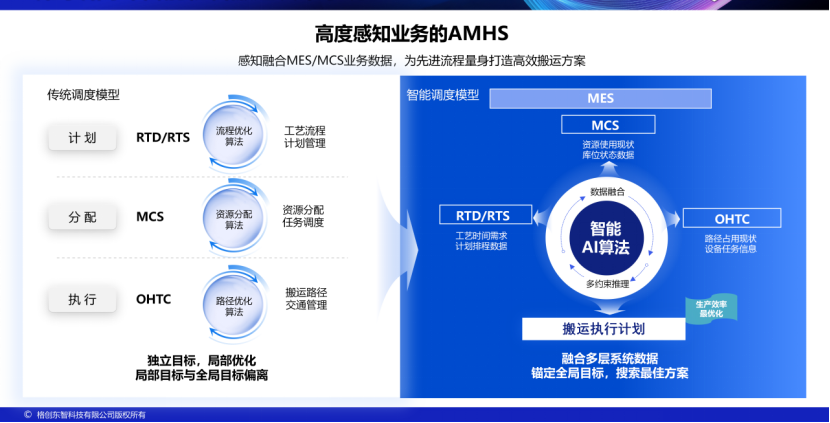
System barriers cause data fragmentation: data from MES (Manufacturing Execution System), MCS (Material Control System), and OHTC (Overhead Hoist Transport Control) cannot be efficiently integrated. Planning, allocation, and execution operate in silos, often contradicting the overall fab optimization goals.
Rigid scheduling struggles with complex conditions. Traditional algorithms based on static rules cannot flexibly adapt to dynamic constraints such as batch order deadlines, equipment resource contention, and track congestion, resulting in high OHT empty runs, long transport waiting times, and efficiency bottlenecks.
Operations and maintenance response relies heavily on experience. When anomalies occur, engineers need to manually query multiple systems for troubleshooting, taking hours to locate faults, missing the optimal recovery window.
The root cause of these problems is not insufficient equipment capability, but the lack of an integrated scheduling system that can integrate global business data, with intelligent judgment and autonomous decision-making capabilities. Targeting this industry dilemma, Wilson Optimus, a subsidiary of Gtrontec, precisely launched the AMHS Smart Logistics Solution, providing a full-process solution for semiconductor fab material handling challenges.
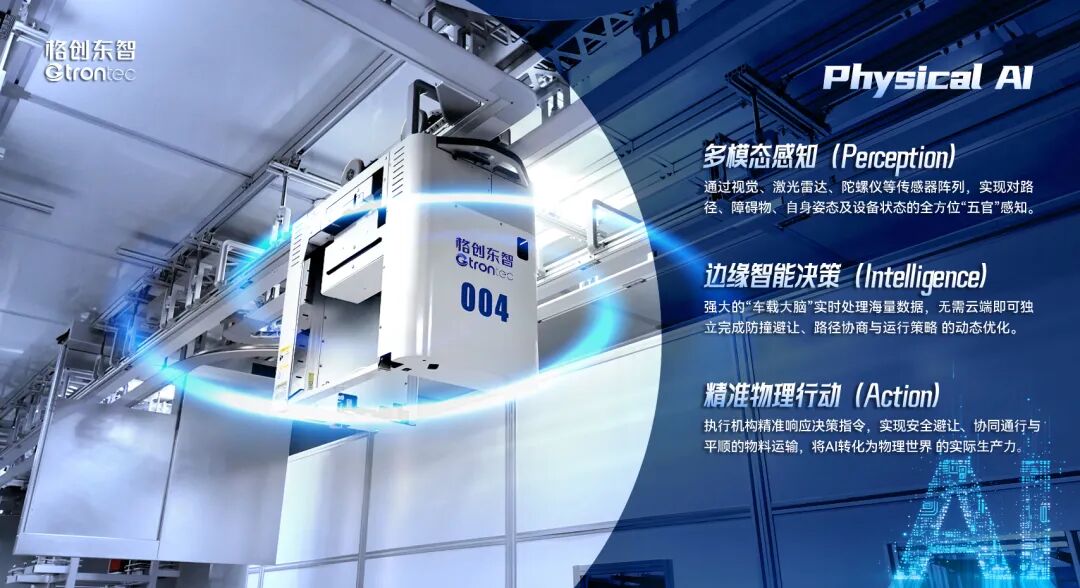
Breakthrough Method: AI+AMHS Smart Logistics SolutionWilson Optimus AI+AMHS Smart Logistics Solution covers all material flow scenarios in semiconductor fabs horizontally, from warehouse storage, inter-line transport to machine loading/unloading. Vertically, it is supported by AI, multi-source data fusion, and Physical AI technology, creating an end-to-end closed-loop intelligent material handling decision system from "brain decision" to "limb execution".
Practical Case: The Path to Production Increase and Efficiency Improvement for an 8-inch Wafer Fab
A top domestic 8-inch wafer manufacturer, whose production line heavily relies on manual material handling, urgently needed to build a high-tempo, fully automated logistics and production system to achieve a capacity ramp-up to 300,000 wafers per month with an 80% reduction in labor, i.e., the goal of "production increase and efficiency improvement".
Wilson Optimus integrated OHT+OHB+Stocker+Conveyor system layout for them, achieving path optimization and intelligent scheduling through RTD+MCS+OHTC system linkage, providing an automated material flow solution covering the entire production line.
Key Achievements
Yield and Capacity Dual Improvement: Eliminate vibration, contamination, and operational errors caused by manual handling, significantly improve production yield, and support capacity ramp-up goals. Full-stack Domestic Autonomous Control: Self-developed hardware and software ensure data security and real-time spare parts supply, providing controllable multi-party assurance. Unified Central Control Platform: Aggregate real-time hardware and software data from the entire fab, transform information into clear insights, enabling managers to achieve precise scheduling and efficient human-machine collaboration.Next Episode Preview: The intelligent scheduling and operation system based on AI Agent will deeply deconstruct the core operation logic of the semiconductor logistics "brain", unlocking more efficient scheduling secrets. Stay tuned!